
Loading, please wait…
Straight-Through Disbursement lets a platform submit a payout to a recipient without creating and activating a party for that recipient. Payouts are funded from the proceeds of the platform's own card acceptance activity.
Acceptance proceeds establish a dedicated payout funding balance. The platform submits a single, self-contained payout request that carries the recipient details and an encrypted payment source, and the payout is executed to the recipient's card through push-to-card rails. No party is created or activated for the recipient as a precondition of payment.
Straight-Through Disbursement is a Payouts capability. It is distinct from Onboard Participant flows, which create and activate a party for a seller or buyer, and from platform settlement configuration completed during implementation.
Platforms that pay large numbers of consumers often cannot require every recipient to complete an onboarding journey before receiving funds, and managing a separate prefunding process adds cost, delay, and reconciliation effort. Straight-Through Disbursement connects money-in and money-out within one integration.
Straight-Through Disbursement helps platforms:
The lifecycle spans configuration, funding, payout, and settlement. Payout activity is API-driven, and lifecycle outcomes are returned as status updates.
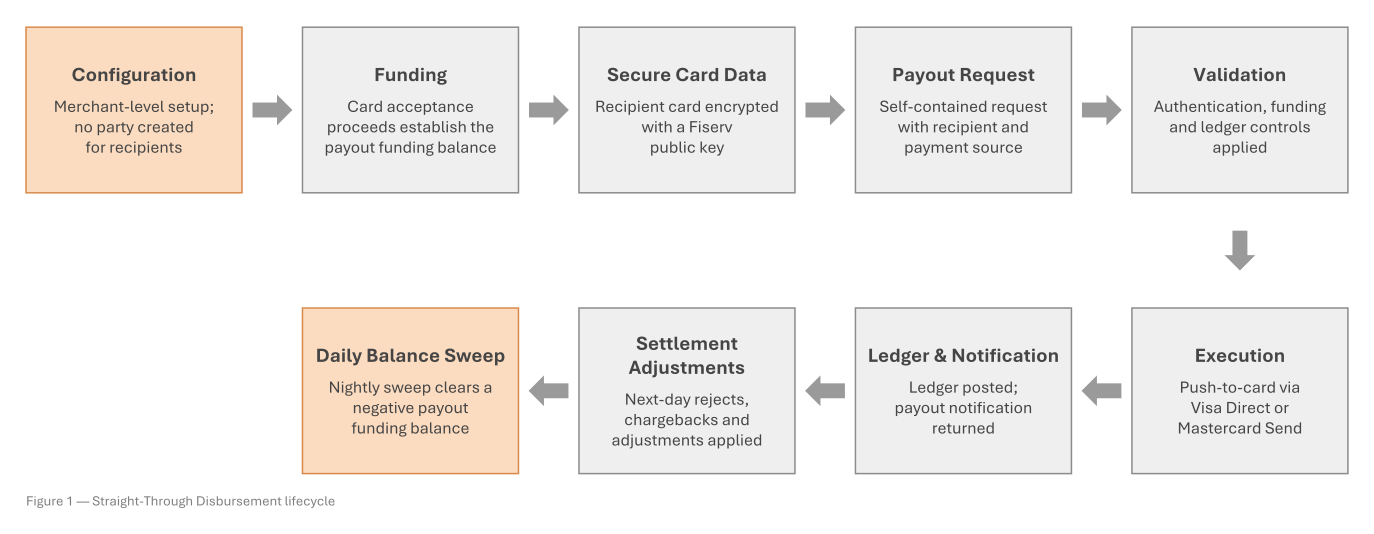
| Stage | Description |
|---|---|
| Configuration | The platform is configured at the merchant level, including straight-through processing without party creation and applicable funding transaction behavior. |
| Funding | Card acceptance proceeds are captured and used to establish the platform's payout funding balance. |
| Secure card data | The platform encrypts the recipient card data with a Multi-Use Public Key (MUPK) to produce encryptionData. |
| Payout request | The platform builds the payment source and submits a self-contained payout request with recipient, payment source, amount, and transaction details. |
| Validation and orchestration | The request is authenticated and validated, and merchant-level funding and ledger controls are applied. |
| Execution | The payout is executed against the available funding balance through the applicable push-to-card rail. |
| Ledger and status | Ledger movements are recorded and a payout notification is returned to the platform with correlating identifiers. |
| Settlement adjustments | Next-day settlement activity, including rejects, chargebacks, and adjustments, is applied to the relevant balances. |
| Daily balance sweep | An automated nightly sweep restores a negative payout funding balance from the acquiring settlement account. |
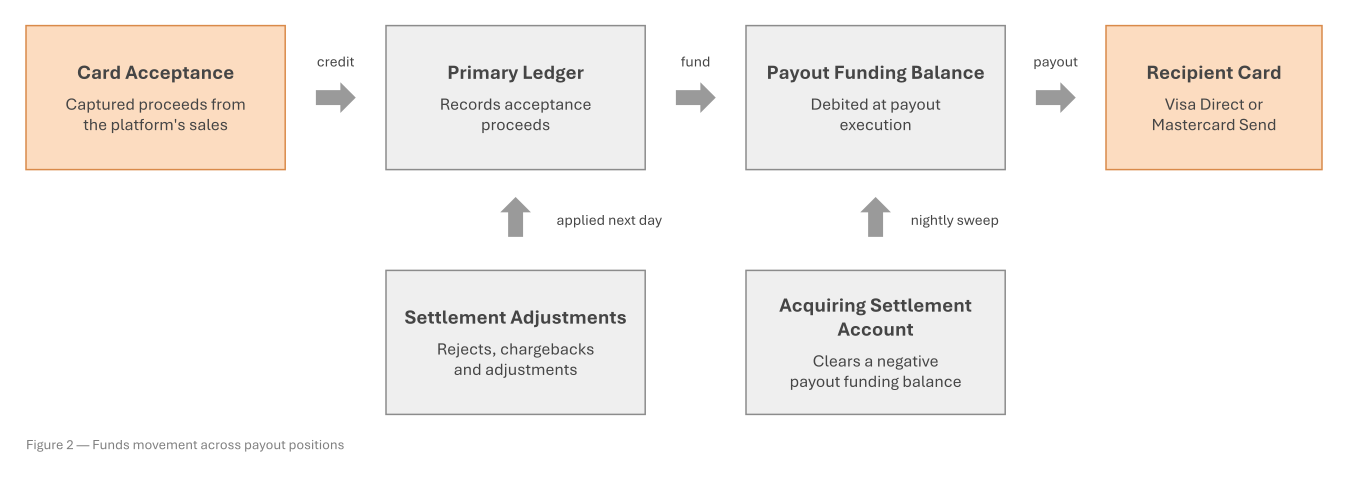
Payouts are funded by the platform's own acceptance activity rather than a separate prefunding step.
Each payout is submitted as a single, self-contained request. The request is processed without checking for, or creating, a party for the recipient.
| Payload category | Content |
|---|---|
| Recipient | Recipient information required for the selected payout rail. |
| Payment source | Recipient card supplied as an encrypted PaymentCard (target.sourceType = PaymentCard), using encryptionData generated with the MUPK. |
| Merchant context | Merchant identification and applicable configuration context. |
| Transaction details | Requested operation, platform transaction reference, and correlation information. |
| Amount | Payout amount and currency. |
| Funding context | Information that associates the payout with the available funding balance. |
| Additional data | Data required for routing, operations, reconciliation, or reporting. |
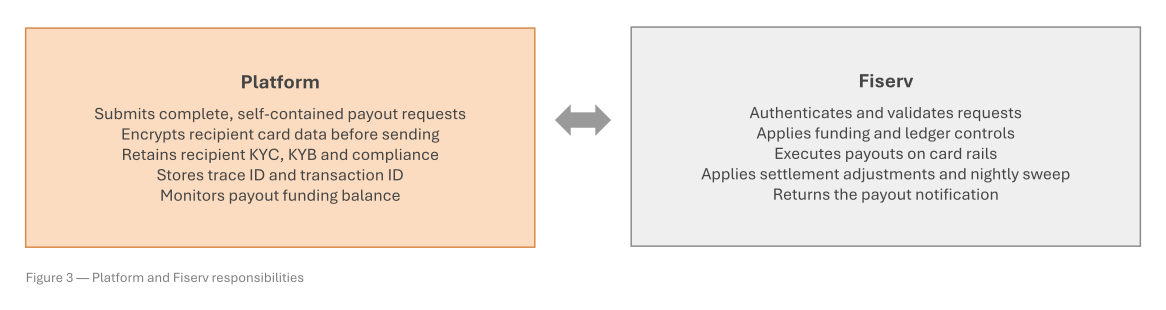
Straight-through processing is configured at the merchant level. When enabled, recipient data flows with the payout request, and no party is created or activated for the recipient before payment.
Under this model, the platform retains responsibility for recipient KYC, KYB, and applicable recipient-level regulatory compliance. Platforms should confirm that their compliance program covers the recipients they pay before enabling this capability.
Payouts are executed as push-to-card disbursements through Visa Direct and Mastercard Send, as applicable to the recipient's card.
Straight-Through Disbursement is delivered through an API-led integration. The platform owns the entire recipient experience and submits payout requests directly through the APIs. No hosted or Fiserv-rendered screens are involved.
This differs from the hosted and embedded models used for Onboard Participant flows, where Fiserv renders or embeds parts of the user-facing experience. Because no party is created for the recipient, there is no recipient-facing flow to render.
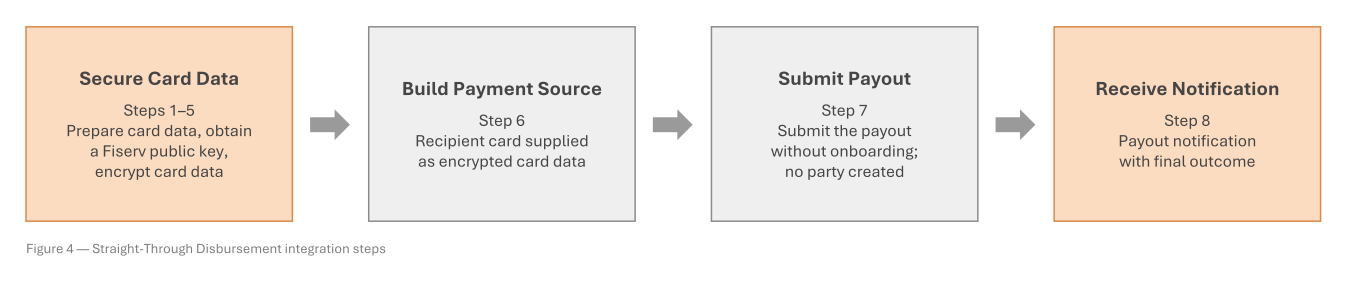
The Straight-Through Disbursement guide in the API documentation walks through eight steps, grouped here by purpose:
| Stage | Guide steps |
|---|---|
| Secure card data | Step 1: Generate unencrypted encryptionBlock; Step 2: Generate encryptionBlockFields; Step 3: Generate key; Step 4: Perform RSA encryption; Step 5: Form encryptionData |
| Build payment source | Step 6: Build the payment source |
| Submit payout | Step 7: Submit the payout without onboarding |
| Receive outcome | Step 8: Receive the payout notification |

Every payout carries correlating identifiers from request through execution, ledger posting, and settlement, so platforms and operations teams can trace activity end to end.
Specific status codes and payout notification events are configured during implementation.
Platforms use Straight-Through Disbursement to: